The Digital, Data-Driven Demonstration Farm

Research Update: Metered Poultry Litter Injection

At a Glance

ETDS Progress

  • Research Topic: Metered Poultry Litter Injection
  • PI: Wes Porter
  • Team: Cody Mathis (MS)
  • Main Objective: Develop a Metering System to Precisely Convey Poultry Litter

Motivation

  • With broadcast application of poultry litter, the chances of runoff and loss of essential nutrients is greater than that of exact placement (such as injection)​​
  • By precisely metering poultry litter, water runoff concerns can be reduced due to direct placement of poultry litter

Proposed Solution

  • Utilize a hopper with offset knives on a shaft inside in order to refine the inconsistent litter material
  • Cost savings from precise placement of nutrients
  • Develop lab scale metering system for conveying poultry litter precisely and consistently

Results to Date

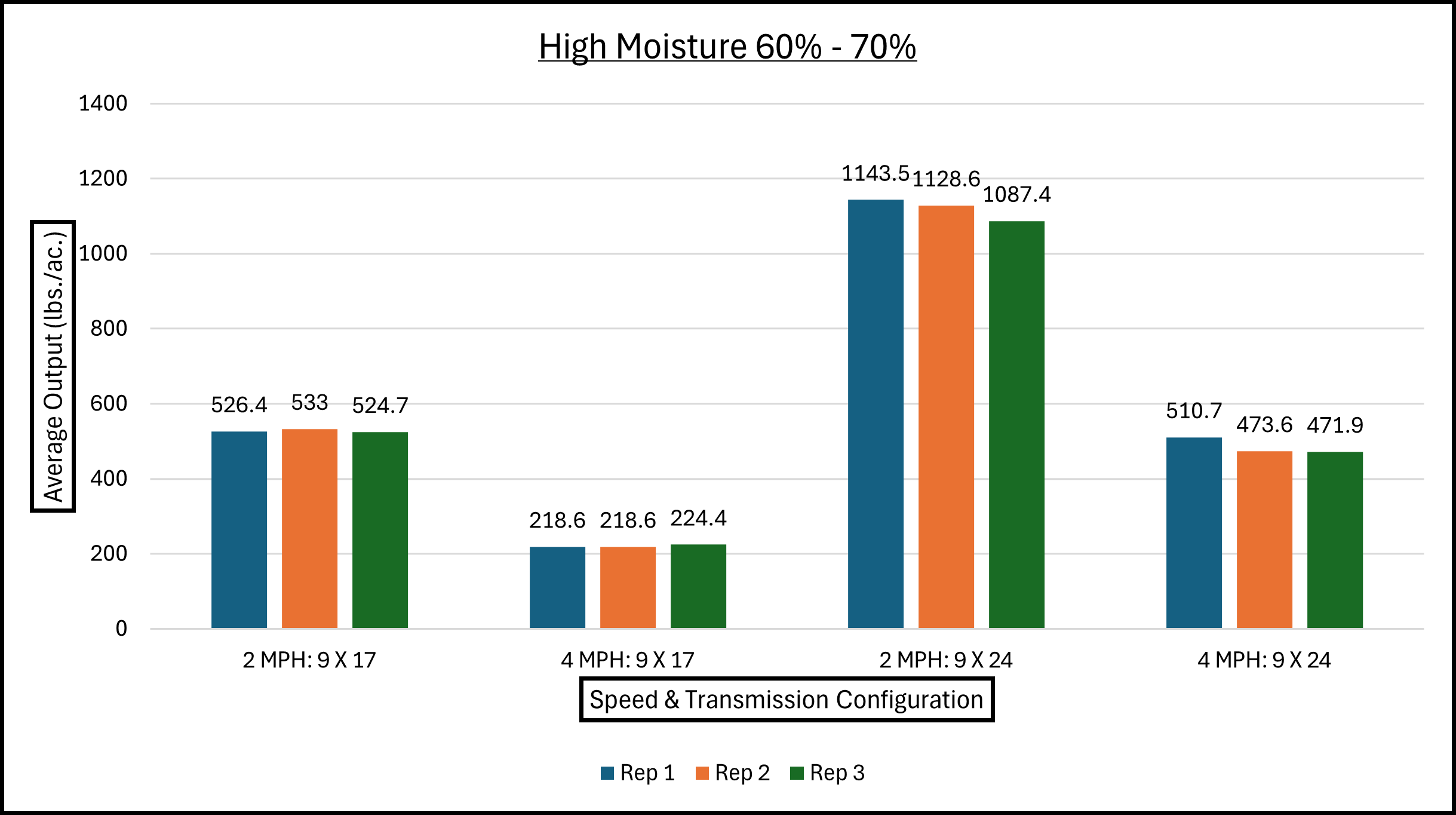
Preliminary results have shown that the metering of poultry litter can allow for reduced overall litter usage.  Graphs 1 and 2 show that we can consistently convey material utilizing the metering system between the different settings.

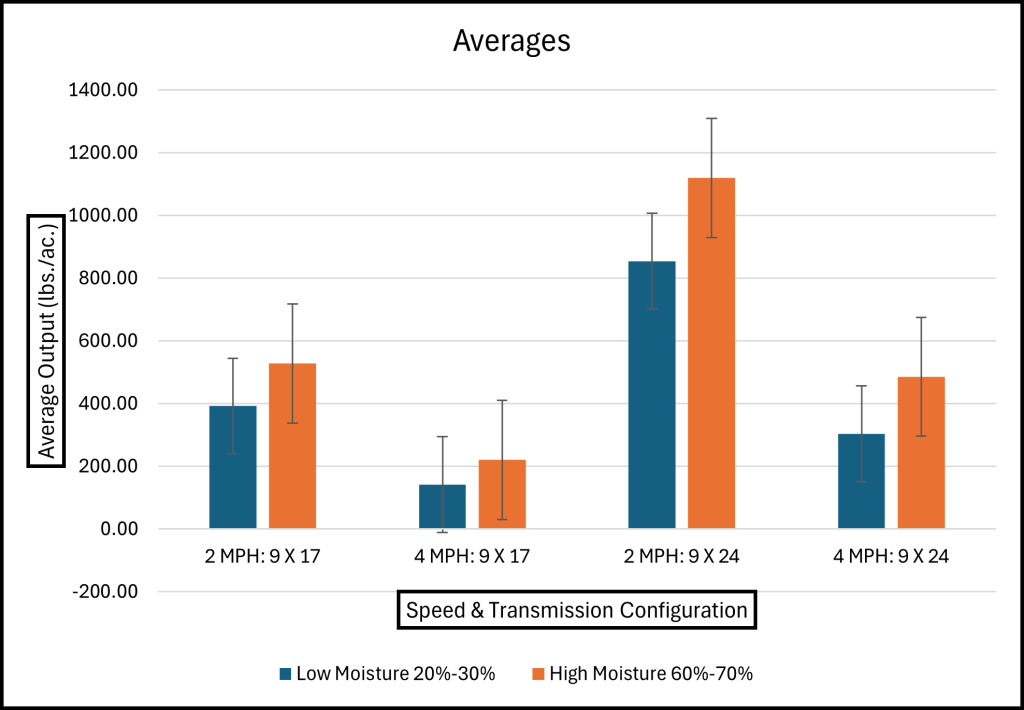
Initial results show that within the higher moisture range, we can convey more material when compared to the same settings using the lower moisture range.

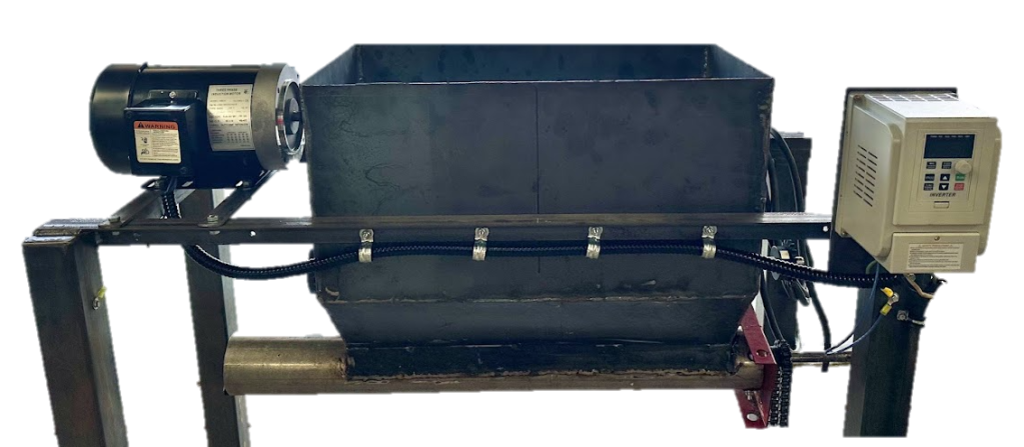
Photo of the Lab test stand for poultry litter metering system. There is a lrage black hopper, connected to a motor on the left and a digital read-out on the right.
Lab test stand for poultry litter metering system

In Figure 3, we see the low moisture and high moisture average outputs across all settings.

Bar chart comparing the output averages of high moisture and low moisture poultry litter, across the four settings. Overall, the high moisture (60-70%) bars are all significantly higher than the low moisture (20-30%) bars. The far left represents the setting "2 MPH: 9 x 17," and depicts a blue bar (low moisture) that ends just below 400 lbs/ac of average output, with a whisker extending from ~250 lbs/ac to ~550 lbs/ac. Beside it, an orange bar (high moisture) ends just above ~550 lbs/ac, with a whisker extending from ~300 lbs/ac to over 700 lbs/ac. The inner left bar pair represents the setting "4 MPH 9 x 17" and depicts a blue bar (low moisture) that ends ~175 lbs/ac, with a whisker than extends from just below 0 lbs/ac to ~300 lbs/ac. Beside it, an orange bar (high moisture) ends just above 200 lbs/ac, with a whisker extending from ~25 to just over 400 lbs/ac. The inner right bar pair represents the setting "2 MPH: 9 x 24" and depicts a blue bar (low moisture) that ends ~850 lbs/ac, with a whsiker extending from ~700 to 1000 lbs/ac. The orange bar beside it (high moisture) ends about 1100 lbs.ac, with a whisker extending from ~900 lbs/ac to 1300 lbs/ac. The far right bar pair represents the setting "4 MPH: 9 x 24" and depicts a blue bar (low moisture) that ends ~300 lbs/ac, with a whisker that extends from below 200 to above 400 lbs/ac. The orange bar (high moisture) ends just under 500 lbs/ac, with a whisker extending from ~300 lbs/ac to just under 700 lbs/ac.
Average overall output material weight based on metering transmission sprocket configuration.

Next Steps

  • Complete lab scale testing of the metering system while texting higher speeds for potentially greater outputs.
  • Implement the metering system onto a full-sized toolbar to begin in-field testing validation, effectiveness, and efficiency.

Citation

  • Thapa, S., Rains, G. C., Porter, W. M., Lu, G., Wang, X., Mwitta, C., & Virk, S. S. (2024). Robotic Multi-Boll Cotton Harvester System Integration and Performance Evaluation. AgriEngineering, 6(1), 803–822. https://doi.org/10.3390/AGRIENGINEERING6010046/S1

Discover more from 4D Farm

Subscribe to get the latest posts sent to your email.