Main Objective: Establish effective variable irrigation thresholds for Georgia peanut production
Motivation
Georgia is the number one peanut producing state in the U.S. planting 850,000 acres in 2024
Roughly half of those peanut acres are irrigated
There has been an increase in the adoption of soil moisture sensors used to schedule irrigation
Proposed Solution
Soil water tension is the force required for plants to take up water from the root zone and is related to how tightly the water is held by soil particles
Maintain or increase peanut yield by using variable soil water tension thresholds to schedule irrigation using soil moisture sensors
Maintain or increase profitability for producers by reducing irrigation inputs
Results to Date
Results in 2024 show no significant differences in yield between any irrigated treatments, but they did yield better than rainfed
Profitability for electric systems is not different between irrigated treatments, but are all more profitable than rainfed
In diesel systems there is no significant difference between any treatment irrigated or rainfed
Due to over 27 inches of rainfall during the growing season, it is likely full soil water tension effects were not observed in 2024
Treatment
0-40 DAP
41-110 DAP
111-Harvest
1
45 kPa
45 kPa
45 kPa
2
70 kPa
45 kPa
70 kPa
3
70 kPa
45 kPa
45 kPa
4
70 kPa
45 kPa
20 kPa
5
45 kPa
45 kPa
70 kPa
6
70 kPa
20 kPa
45 kPa
7
20 kPa
70 kPa
45 kPa
8
45 kPa
70 kPa
70 kPa
9
Rainfed
Irrigation threshold treatments illustrating the shift in treatments throughout the growing season.
DAP = Days after Planting. kPA = kilopascals, the unit to measure soil water tension.
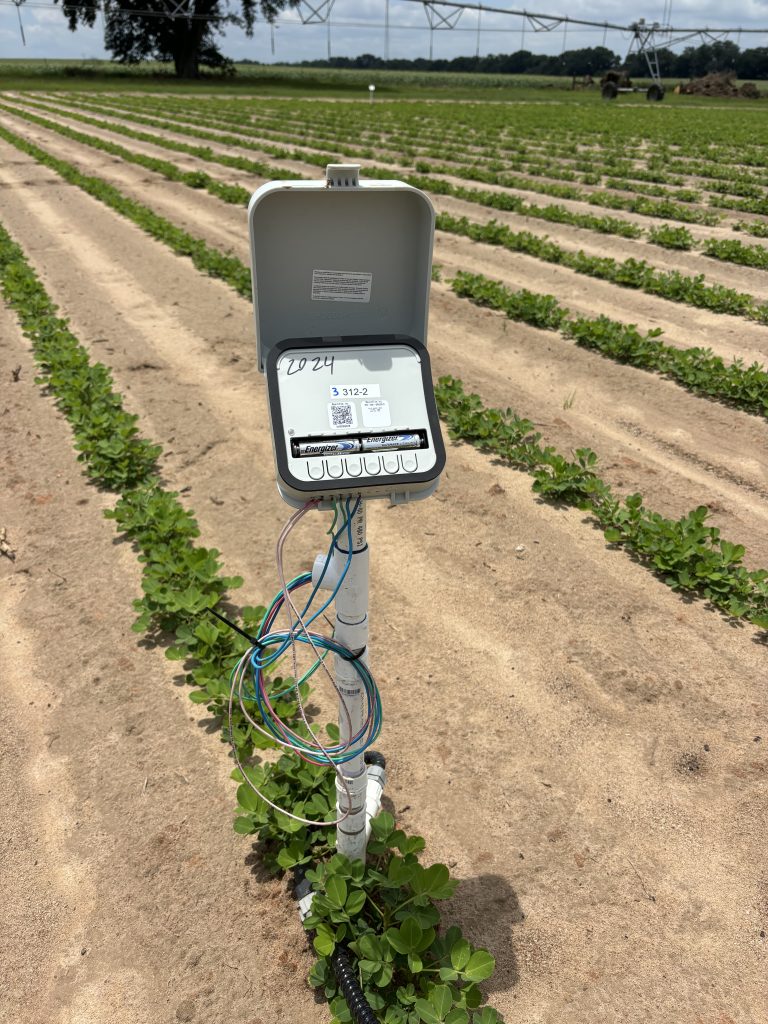
Soil moisture sensor installed in 2024
Next Steps
This study will be repeated in 2025 using the same treatments. We are continuing work to analyze seed quality between treatments.
Citation
Liu, Y., Smith, A., Cambell, B., Fonsah, G., & Escalante, C. (2024). Budgets—Extension | Agricultural & Applied Economics. University of Georgia Cooperative Extension. Athens, GA. https://agecon.uga.edu/extension/budgets.html