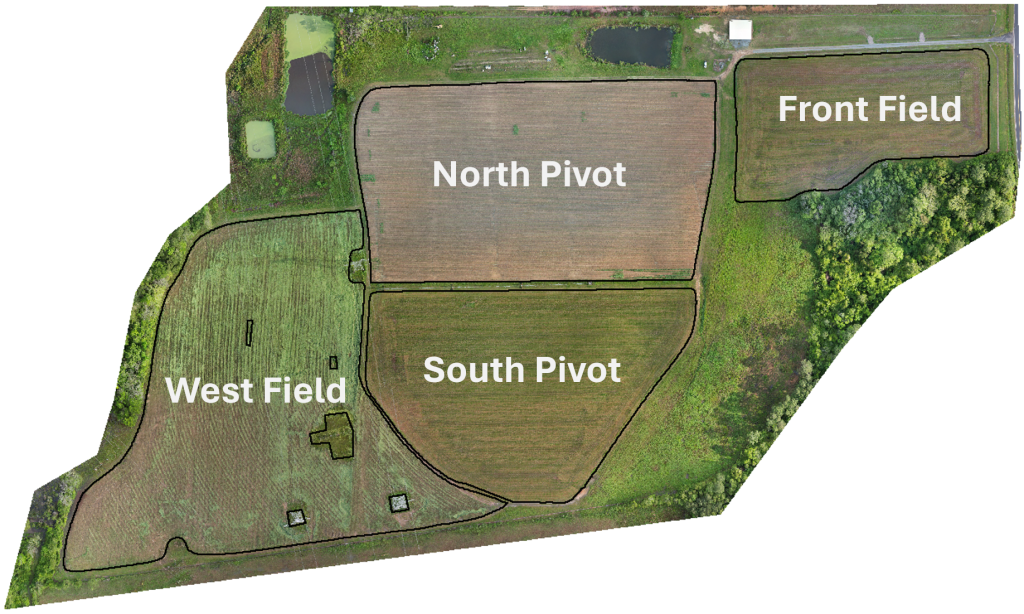
Welcome to the first newsletter. The fall months were busy with harvesting the existing crops, soil testing, and prepping the fields for winter cover crops. Soil samples were collected to a depth of 6.5 in. on a 1-acre grid. Soil electrical conductivity (EC) was measured with a Veris. After performing these operations, the Front and South Pivot fields were seeded in Nelson annual ryegrass at a rate of 25 lbs. per acre for the ABAC Beef Unit to cut and bale. North Pivot field was seeded in a mixture of Wrens Abruzzi cereal rye (55 lbs. per acre) and crimson clover (15 lbs. per acre) to provide soil protection during the winter and to cover in between the rows after the corn is planted in March.
The West field underwent a deep turn with a bottom plow in preparation for peanuts this spring and then was seeded with cereal rye using a grain drill at a rate of 135 lbs. per acre. After seeding the field, a pass was made with a KMC ResiTill, a vertical tillage implement, set to a shallow depth to level the field for spring planting.
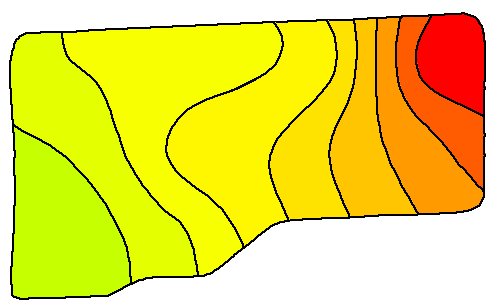
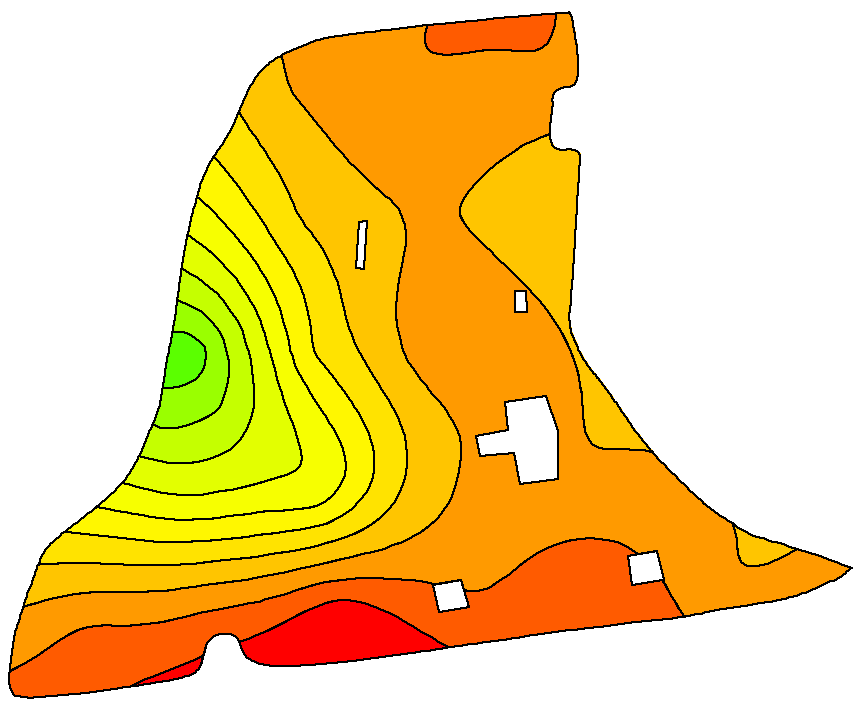
Full soil test results can be found in the upcoming soil health report. Data is available now if you want to see it. Some highlights are discussed here. Areas of very low pH in the Front and West fields as seen in Figures 1 and 2 respectively.
The soil results from Waters Lab provided the soil pH and buffer pH, but the UGA production guides use lime buffering capacity and pH to determine rates. Dr. Harris was consulted on determining the lime rates, and he provided a chart to make this conversion. A meeting with Dr. Virk was held to review the prescription maps and rates. Next, ag lime was applied according to the UGA peanut production guide for using a variable rate prescription. Due to weather constraints, lime was only applied to the Front and West fields. Lime will be applied in the coming weeks to both North and South Pivot fields according to the corn and cotton production guidelines. A detailed write-up on the lime application is coming soon.
Soil moisture sensor locations were determined for each field based on EC zone, elevation, and position under the pivot’s irrigation sections. Section control is being added before the 2024 crop season. Moisture sensors were placed to ensure scheduling could be completed by sections. Dr. Porter’s team from UGA installed the sensors and linked them to RealmFive to upload data.
Operations:
Water needs: None, 3.13 inches of rain this week. The forecast for the upcoming week shows several chances.
Sensors: Adding a RealmFive weather station to have a single vendor. Current weather data is coming from the Valley weather station at the farm. It is not going away.
Reports coming out next week: soil test results and cover crops.
Subscribe to get the latest posts sent to your email.