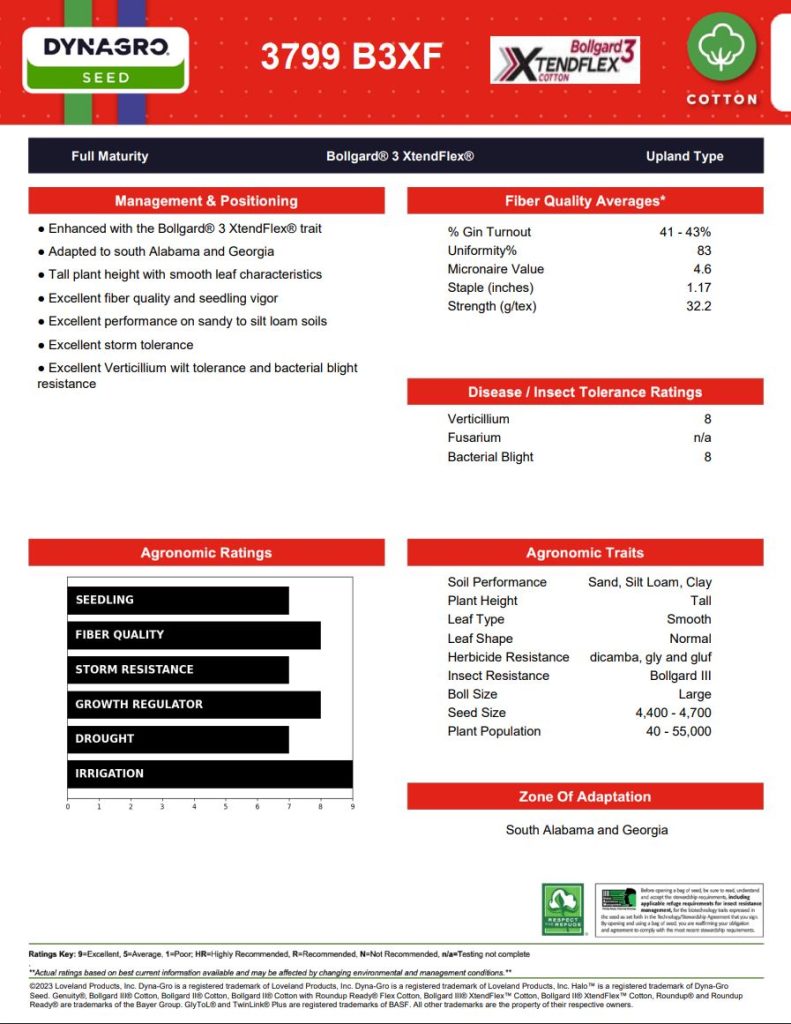
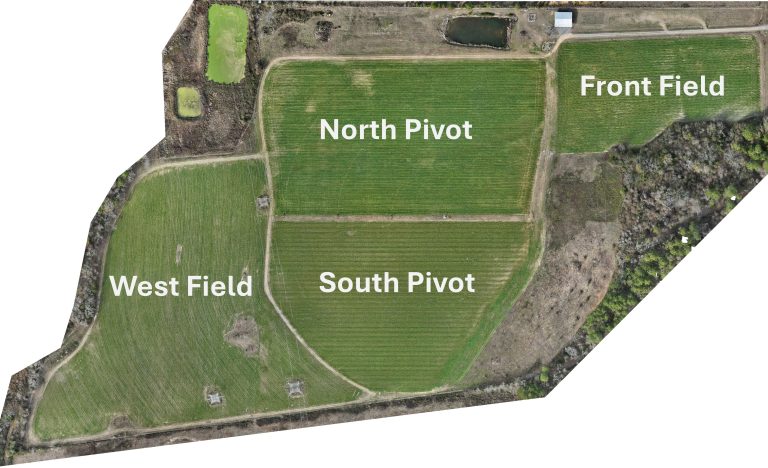
Cotton was chosen for Front Field’s 2026 crop season to follow last year’s cotton crop. This will provide two years in between peanut crops for this field. The yield goal for this crop is set at 1,000 pounds per acre because of the lack of irrigation. Dyna-Gro DG3799 cotton will be planted in Front Field at ABAC’s DATA Farm (Figure 1). This field is a 6.2-acre non-irrigated field. The soil is classified as Tifton Loamy Sandy with a 2 to 5 percent slope according to USDA’s Web Soil Survey tool. For the 2026 winter season, the plan is to graze livestock, so a mixture of oats, cereal rye, clover, and turnips was planted following the 2025 cotton harvest. Prior to planting the winter grazing mix this field was deep turned with a bottom plow. This operation was performed to bury the seed bank generated by a high pigweed population during the 2025 crop season. Table 1 shows the crop rotation history of this field dating back to 2017 when ABAC purchased the property.
| Year | Crop |
|---|---|
| 2025 | Cotton |
| 2024 | Peanuts |
| 2023 | Cotton |
| 2022 | Soybeans |
| 2021 | Cotton |
| 2020 | Soybeans |
| 2019 | Cotton |
| 2018 | Soybeans |
| 2017 | Cotton |
This document outlines the season plan for the crop based on the print version of the 2024 UGA Cotton Production Guide (the digital copy posted is still the 2023 UGA Cotton Production Guide1), and UGA Crop Code Sheet for 1000 lb/ac Cotton2. Appendix A contains an operational timeline for this year’s crop in Front Field. The following sections provide details of the planned operations.
Before planting, the cover crop will be terminated using herbicides; details are listed in the weed management section. This operation will be performed using a Vans 12 row sprayer with a 36.5-foot boom, equipped with AgLeader ISOBUS rate controller with 5 sections.
Each year the guidance line for strip-till and planting is shifted 18 inches. This practice allows for management of compaction by shifting the row middle where machine traffic passes. This year the strip-till unit will shatter any compaction created during last season. Shifting the row also allows plants to utilize nutrients the previous year’s crop may not have accessed in the row middle.
Prior to performing strip-till and planting it is important to verify the GPS offsets of the tractor and implement profiles in the guidance system. If the profile of the strip-till unit and planter do not match this could create emergence issues because the seed is not deposited in a clean slit of soil created by the strip-till unit.
One week after the grazing mix is terminated, a 4-row KMC 6700 Series Rip/Strip with a cover crop roller accessory will be run through the field to shatter any compaction in the rooting zone and remove cover crop residue for the planter row units. This method creates a clean path for the planter row units but leaves a mat of cover crop residue in between the rows for weed suppression and moisture retention.
This year the field will be managed using conventional tillage due to an emergence study for John Deere. Prior to planting the cover residue will be mixed into the soil with a Sunflower disk harrow to create a clean seed bed for planting. The John Deere team requested conventional tillage so they can track daily emergence with a UAV from Sentera.
The cotton planting population target rate will be 22,000 seeds per acre for 1.5 seeds per foot. The actual planter setting will be 25,000 seeds per acre to account for germination rates. John Deere is sending a planter equipped with their latest technology to plant the field. The planter will be equipped with John Deere’s new E-Depth technology that can adjust seeding depth automatically using a prescription map. The seeding depths are set based on soil texture zones determined using soil ECa measured with the Veris implement. The depths are set at 0.75 inches in heavier texture zones, 1 inch in average texture zones, and 1.5 inches in lighter texture zones.
The seed variety chosen from Dyna-Gro was DG3799. This is an early—mid-maturity variety that was one of the top performers for lint yield and seed cotton yield from dryland in the 2025 UGA Variety Trials3 in Tifton, GA. Appendix C contains information published by Dyna-Gro for this variety. The variety also contains Bollgard 3 XtendFlex technology, which protects against armyworm and cotton bollworm. This seed has herbicide-resistant technology that allows the use of glyphosate, glufosinate, or dicamba.
The planting date will be chosen using the UGA Cotton Production Guide4 (2024) methodology that uses 4-inch soil temperatures (65oF minimum over 3 consecutive days) and a 5-day weather forecast showing warming conditions during the period between April 1st and May 25th. Two RealmFive soil temperature sensors at a 4-inch depth in both fields to monitor soil temperature. The production guide1 also states on page 76, “Early planting while moisture persists increases the likelihood of successful planting in non-irrigated fields.”
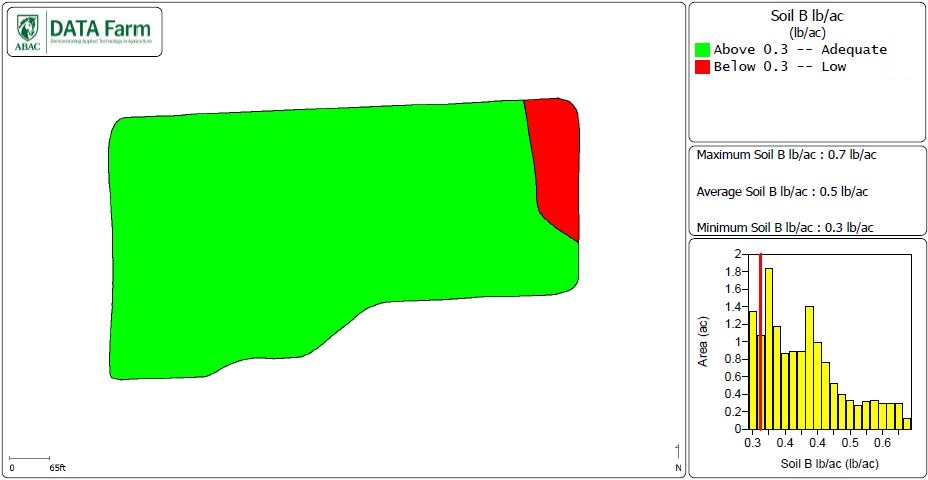
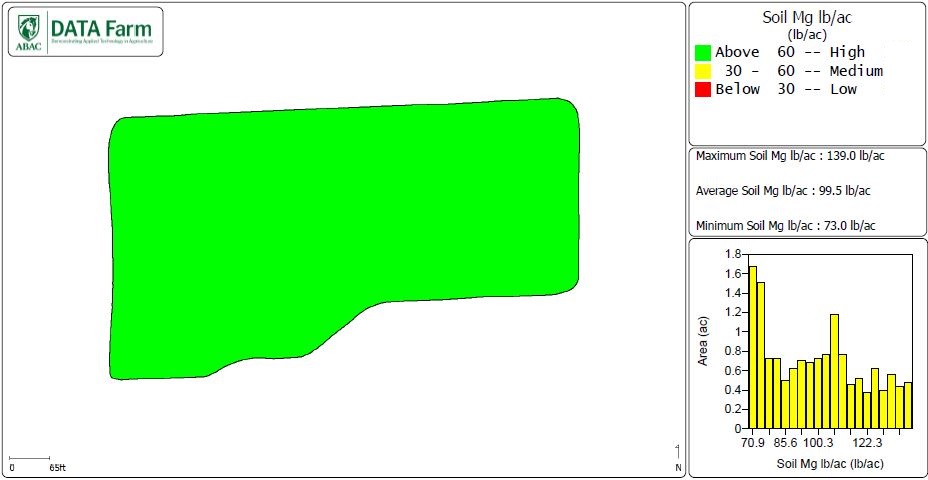
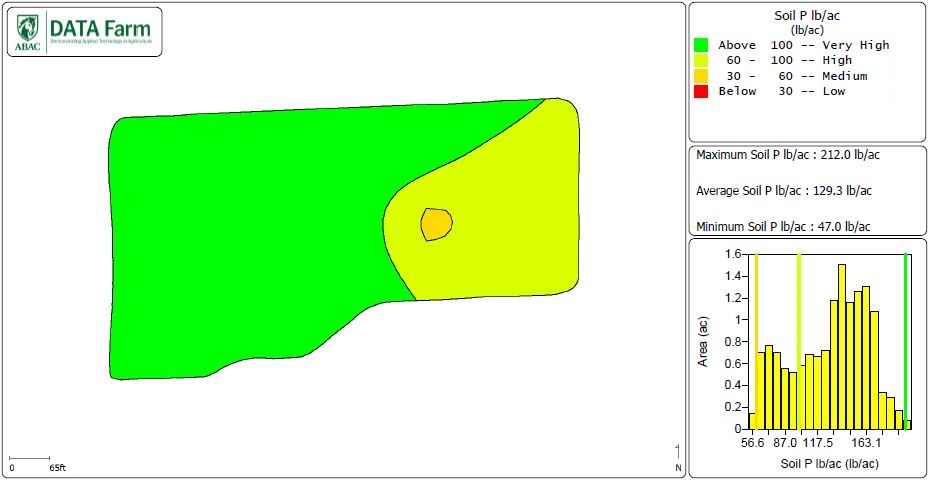
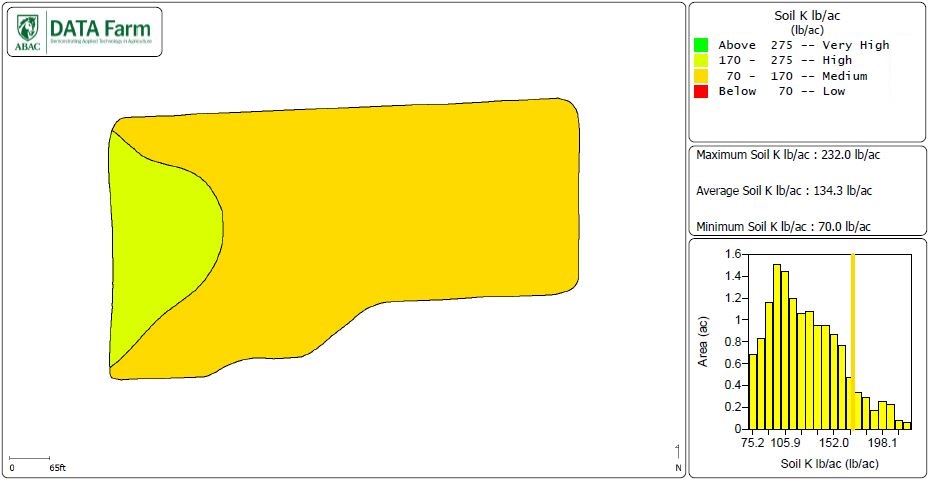
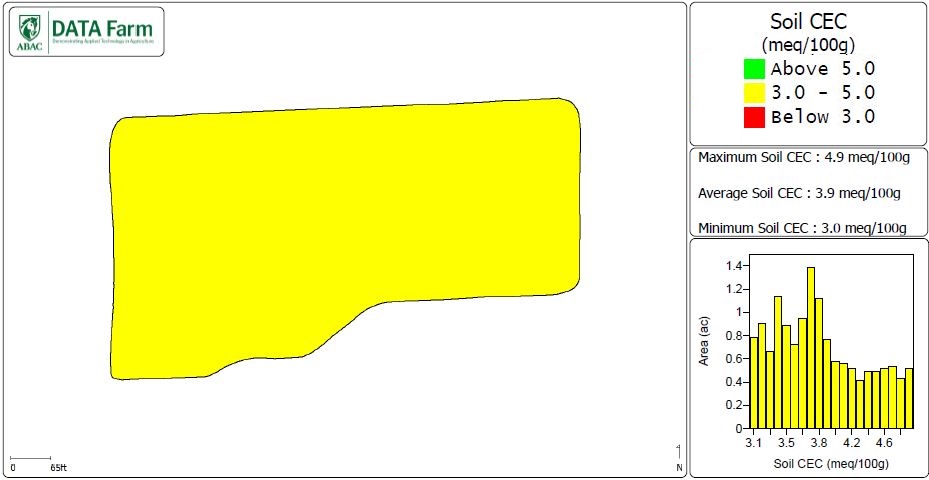
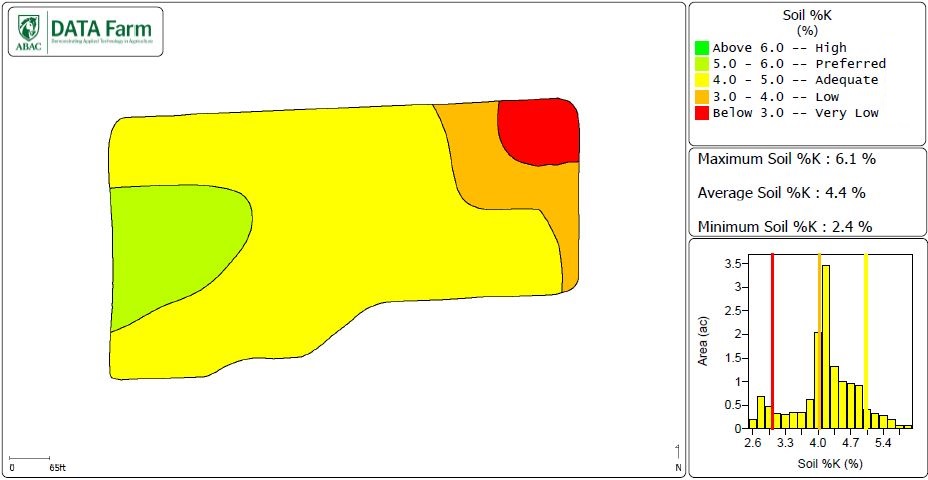
Total nitrogen (N), phosphorus (P), and potassium (K) fertility needs for the 2026 season are shown in Figure 2. Rates were determined based on the UGA soil test handbook crop needs5, as indicated by soil test results and target yield goal. The soil test results for Front field are in Appendix D and E of this document. The N rate (75 lbs./ac.) is constant across the field. N application will be split into a pre-plant application of 25 lbs./ac. and a side dress application of 50 lbs./ac. The side dress application will occur between the first square and the first bloom. The P and K needs vary based on results of soil tests.
Front Field soil tested high in P for the entire field except for a small spot (0.2 acres). This spot is not significant enough to justify application for that nutrient. There were three zones in the field for K needs based on base saturation levels: one is 1.4 acres needing 90 lbs. K2O /ac., 4 acres needing 60 lbs. K2O /ac., and a small 0.8-acre area needing no K2O.

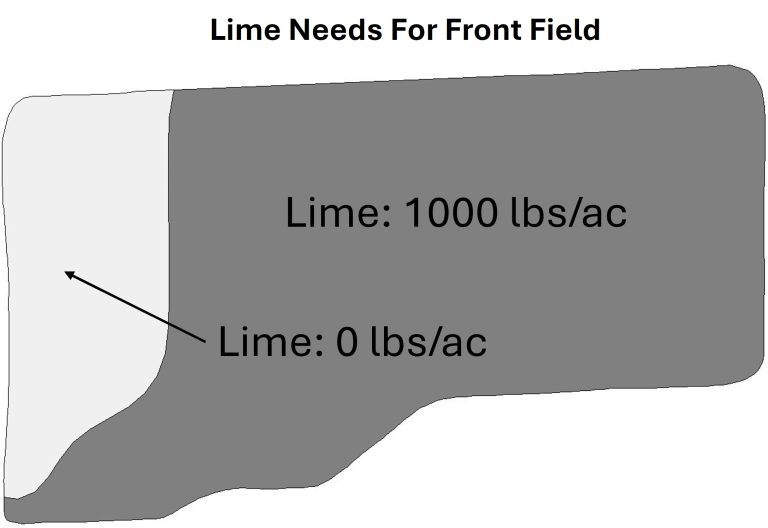
A prescription map for lime was created in Ag Leader SMS using the grid soil results from the fall soil test results (see Appendix D for results). The pH was above 6 in a 1.3-acre zone so no lime, but the rest of the field varied from 5.7 – 5.9 so a prescription map for lime was created. Figure 3 shows the prescription map used by Ty Ty Ag Services to apply lime using a Vector spreader truck. Lime was applied on January 7th 2026, to allow time for the lime to react with the soil.
Phosphorus (P), potassium (K), and nitrogen (N) pre-plant needs in the field are shown in Figure 4. Note that nitrogen application for cotton is a constant rate per the UGA recommendation. An initial 25 lb./ac. rate of nitrogen is recommended during pre-plant fertilizer application. All applications are from products that are readily available in granular form (diammonium phosphate (DAP 18-46-0), potash (0-0-60), ammonium sulfate (21-0-0–24S), or 18% liquid nitrogen(18-0-0-3S)).

To address potassium variability, potash (0-0-60) will be applied at three different rates, then an at-plant application of 18% liquid nitrogen (18-0-0-3S) will meet nitrogen needs. (Figure 5)

Additional fertilizer applications are needed to meet UGA recommendations (Figure 2). Applications are constant rates.
Plant growth regulators (PGR) such as mepiquat are used as a management tool to reduce vegetative growth in cotton. Optimal growth control will result in plant heights that maximize harvest efficiency and prevent lodging. If plant growth is vigorous, the first application in a dryland field should occur prior to first bloom with a rate of 8 – 16 oz/ac. A follow up treatment after two weeks may be needed if vigorous plant growth continues.
Estimated cost for 2 applications: $1.92/ac
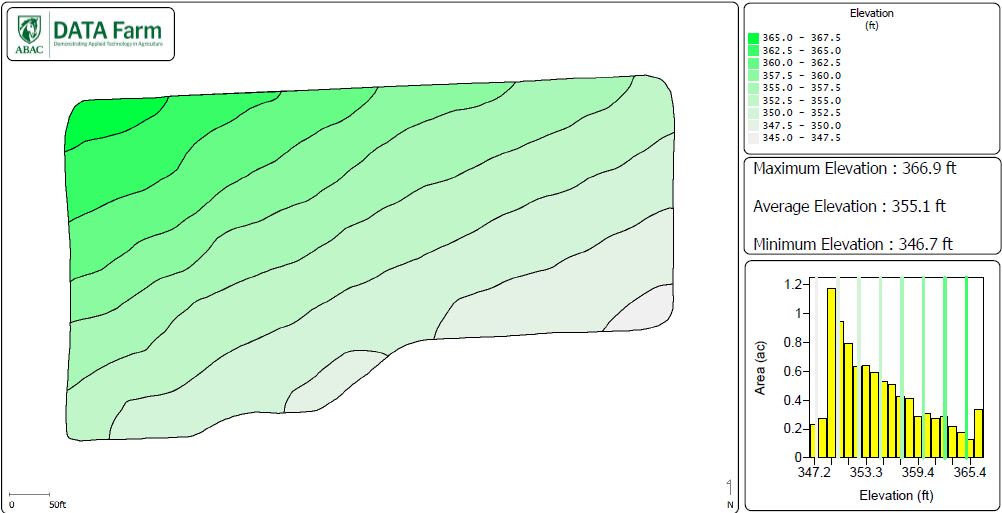
Even though this field lacks irrigation capabilities, soil temperature and moisture levels will still be monitored. Watermark soil moisture sensors will be installed at depths of 8, 16, and 24 inches after plant emergence. The temperature sensor will be 4 inches deep. Data is transmitted to the RealmFive cloud through the weather station at the farm. The location for the field sensors was chosen based on EC zones and elevation. Details on the process are outlined in the 4D Farm Soil Sensor documentation.
Since the field will be managed using conventional tillage, weed management for the crop will begin with the cover crop termination using tillage. The split pre-plant incorporated (PPI) application recommended in the UGA Pesticide Management Handbook Cotton Section6 will be implemented. This program recommends spraying Pendimethalin (Prowl H2O, 2 pt/ac) with Fomesafen (Reflex 2s, 10 oz/ac) then shallow integration into top 2 inches of soil within 1 week of planting.
An Extension article from Dr. Culpepper7 recommends following pre-plant and pre-emerge applications with two post-emergence spray applications. The first will be made 15 to 17 days after planting using a combination of Glufosinate (Liberty, 29-43 oz/ac), Glyphosate (RoundUp PowerMax 3, 21 – 60 oz/ac), and S-Metolachlor (Dual Magnum, 1 pt/ac). The second will be made 15-17 days after the first application using a combination of Glufosinate (Liberty, 29-43 oz/ac) and S-Metolachlor (Dual Magnum, 1 pt/ac). A directed layby application of Diuron (1.6 – 2.4 pt/ac) with MSMA (2 pt/ac) will be made to control weeds without applying to the cotton plants.
An application of UGA’s “Three-Way” defoliation mixture from the UGA Cotton Production Guide will be made. This mixture consists of Ethephon (32 oz./ac.), Thidiazuron (4 oz./ac.), Tribufos (12 oz./ac.) to remove the leaves and open the remaining bolls for harvest. The field will be monitored over the following two weeks to determine when the leaves have fallen, and the remaining bolls are open for harvest. Due to requirements for the John Deere planter study, the cotton will be harvested using a 2025 or newer John Deere CP770 roller picker which has row by row yield monitoring capabilities.
| Projected Costs | $ | $/ac |
|---|---|---|
| Seed | 905 | 146 |
| Fertility | 802 | 129 |
| Plant Growth Regulators | 12 | 2 |
| Irrigation | TBD | TBD |
| Weed Management | 397 | 64 |
| Insect/Disease Management | TBD | TBD |
| Harvest | TBD | TBD |
| Total | 2,115 | 341 |
| Projected Income | $ | $/ac |
| 1,000 lb lint/ac @ $0.67 | 4,154 | 670 |
| Total | 4,154 | 670 |
| $ | $/ac | |
| Profit / Loss | 2,039 | 329 |
This material is based upon work that is supported by the National Institute of Food and Agriculture, U.S. Department of Agriculture under award number 2023-68016-39403. Any opinions, findings, conclusions, or recommendations expressed in this publication are those of the author(s) and do not necessarily reflect the view of the U.S. Department of Agriculture. Website maintained by the Southern IPM Center.
For more information and resources about the project, please explore the other pages of this website.
This document was authored by Nick Gladden and reviewed by Alex McLemore and Erin Porter. Abraham Baldwin Agricultural College, Tifton, GA, 31793.
| Milestone description | Equipment | Product | Width (ft) | Operation Speed (mph) | Field Eff. (%) | Operation Time | Start | Days | Days Before Planting | Days After Planting |
|---|---|---|---|---|---|---|---|---|---|---|
| Mow Cotton Stalks | John Deere 6195 and John Deere MX15 Mower | 12 | 4 | 80 | 1.3 | 10/1/2025 | 1 | 212 | ||
| Pull Cotton Stalks | John Deere 6195 and Besler 4 row stalk puller | 12 | 10 | 80 | 0.5 | 10/6/2025 | 1 | 207 | ||
| Disked Stalk Residue | John Deere 6195 and Sunflower 1234 disk | 20 | 5 | 80 | 0.6 | 10/7/2025 | 1 | 206 | ||
| Deep Turn | Case Farmall and John Deere switch plow | 8 | 4 | 80 | 2.0 | 10/21/2025 | 1 | 192 | ||
| Smooth Field | Case Farmall and KMC Field Cultivator | 12 | 4 | 80 | 1.3 | 10/22/2025 | 1 | 191 | ||
| Soil Sample | 1.0 | 10/22/2025 | 1 | 191 | ||||||
| Plant Cover Crop | John Deere 6195 and John Deere 450 Grain Drill | 15 | 4.5 | 70 | 1.1 | 11/13/2025 | 1 | 169 | ||
| Spread Lime | Fertilizer Dealer Spreader Truck | Lime | 30 | 6 | 70 | 0.4 | 1/7/2026 | 1 | 114 | |
| Terminate Cover | Case Magnum and KMC Resi-Till | 20 | 4 | 80 | 0.8 | 4/17/2026 | 1 | 7 | ||
| Strip Till | John Deere 6195 and KMC Gen 1 StripTill | 12 | 4 | 80 | 1.3 | 4/24/2026 | 1 | 14 | ||
| Pre-Plant Fertilizer | John Deere 6195 and Chandler Variable Rate Spreader | Potash | 30 | 6 | 70 | 0.4 | 4/27/2026 | 1 | 4 | |
| Pre-Plant Herbicide | John Deere 6195 and Red Ag Leader Sprayer | Prowl, Reflex | 36 | 6 | 80 | 0.3 | 4/27/2026 | 0 | ||
| Incorporate Herbicide | Case 200 Magnum and Sunflower 1234 Disk | 20 | 5 | 80 | 0.6 | 4/27/2026 | 0 | |||
| Plant Cotton | John Deere 6R and ExactEmerge Planter | DG3799 Cotton Seed, Imidacloprid | 18 | 5.5 | 70 | 0.7 | 5/1/2026 | 1 | 0 | |
| At Plant Fertilizer | John Deere 6195 and LMC 4-row Nitrogen Applicator | 18-0-0-3 | 12 | 4 | 75 | 1.4 | 5/1/2026 | 0 | ||
| Emergence Count | 1.0 | 5/13/2026 | 1 | 12 | ||||||
| Postemergence Herbicide 1 | John Deere 6195 and Red Ag Leader Sprayer | Liberty, Roundup PM3, Dual Magnum | 36 | 5 | 80 | 0.4 | 5/16/2026 | 1 | 15 | |
| Postemergence Herbicide 2 | John Deere 6195 and Red Ag Leader Sprayer | Liberty, Dual Magnum | 36 | 5 | 80 | 0.4 | 5/31/2026 | 1 | 30 | |
| PGR Application | John Deere 6195 and Red Ag Leader Sprayer | Mep42 | 36 | 5 | 80 | 0.4 | 6/18/2026 | 1 | 48 | |
| Fertilizer Application | John Deere 6195 and LMC 4-row Nitrogen Applicator | 18-0-0-3 | 12 | 4 | 75 | 1.4 | 6/25/2026 | 1 | 55 | |
| PGR Application | John Deere 6195 and Red Ag Leader Sprayer | Mep42 | 36 | 5 | 80 | 0.4 | 7/2/2026 | 1 | 62 | |
| Directed Herbicide Spray | John Deere 6195 and Direct Sprayer | Diuron + MSMA | 12 | 5 | 80 | 1.1 | TBD | 1 | ||
| PGR Application | John Deere 6195 and Red Ag Leader Sprayer | Mep42 | 36 | 5 | 80 | 0.4 | 7/16/2026 | 1 | 76 | |
| Defoliation | John Deere 6195 and Red Ag Leader Sprayer | Setup 6SL, TDZ 4SC, Folex 6EC, Trivium | 36 | 5 | 80 | 0.4 | TBD | 1 | ||
| Harvest | John Deere CP770 Roller picker with yield monitor | 18 | 5 | 80 | 0.7 | TBD |
| Field Size | 6.2 ac | |
|---|---|---|
| Price | $/ton | $/lb |
| DAP | 888 | 0.44 |
| Potash | 475 | 0.24 |
| Ammonium Sulfate | 513 | 0.26 |
| 18-0-0-3 | 265 | 0.13 |
| Spreader | Side-Dress | |
|---|---|---|
| Width | 50 ft | 12 ft |
| Speed | 6 mph | 5 mph |
| Efficiency | 80% | 80% |
| Zone 1 | 1.1 | ac | Product | N | P | K | S | |
|---|---|---|---|---|---|---|---|---|
| N | 0 | lb/ac | DAP | 18% | 46% | 0% | 0% | |
| P2O5 | 0 | lb/ac | Potash | 0% | 0% | 60% | 0% | |
| K20 | 90 | lb/ac | Ammonium Sulfate | 21% | 0% | 0% | 24% | |
| Cost | N | P | K | S | ||||
| MAP | 0 | lb/ac | $- | Provides: | 0 | 0 | ||
| Potash | 150 | lb/ac | $35.63 | Provides: | 90 | |||
| AMS | 0 | lb/ac | $- | Provides: | 0 | 0 | ||
| Cost | ||||||||
| Field Operation | 29 | ac/hr | 0.2 | Labor | $15.00 | $3.20 | ||
| Fuel | 6.5 | gal/hr | 1.4 | Gallons of Fuel | $3.35 | $4.64 | ||
| Travel to Dealer | 2 | hr | 2.0 | Labor | $30.00 | |||
| Fuel | 3.6 | gal/hr | 7.2 | Gallons of Fuel | $3.35 | $24.12 | ||
| $61.96 | ||||||||
| Operation Cost | $45.62 | per acre | Total | $50.18 |
| Zone 2 | 4 | ac | Product | N | P | K | S | |
|---|---|---|---|---|---|---|---|---|
| N | 0 | lb/ac | DAP | 18% | 46% | 0% | 0% | |
| P2O5 | 0 | lb/ac | Potash | 0% | 0% | 60% | 0% | |
| K20 | 60 | lb/ac | Ammonium Sulfate | 21% | 0% | 0% | 24% | |
| Cost | N | P | K | S | ||||
| MAP | 0 | lb/ac | $- | Provides: | 0 | 0 | ||
| Potash | 100 | lb/ac | $23.75 | Provides: | 60 | |||
| AMS | 0 | lb/ac | $- | Provides: | 0 | 0 | ||
| Cost | ||||||||
| Field Operation | 29 | ac/hr | 0.2 | Labor | $15.00 | $3.20 | ||
| Fuel | 6.5 | gal/hr | 1.4 | Gallons of Fuel | $3.35 | $4.64 | ||
| Travel to Dealer | 2 | hr | Labor | $- | ||||
| Fuel | 3.6 | gal/hr | 0.0 | Gallons of Fuel | $3.35 | $- | ||
| $7.84 | ||||||||
| Operation Cost | $25.71 | per acre | Total | $102.84 |
| Zone 3 | 1.1 | ac | Product | N | P | K | S | |
|---|---|---|---|---|---|---|---|---|
| N | 0 | lb/ac | DAP | 18% | 46% | 0% | 0% | |
| P2O5 | 0 | lb/ac | Potash | 0% | 0% | 60% | 0% | |
| K20 | 0 | lb/ac | Ammonium Sulfate | 21% | 0% | 0% | 24% | |
| Cost | N | P | K | S | ||||
| MAP | 0 | lb/ac | $- | Provides: | 0 | 0 | ||
| Potash | 0 | lb/ac | $- | Provides: | 0 | |||
| AMS | 0 | lb/ac | $- | Provides: | 0 | 0 | ||
| Cost | ||||||||
| Field Operation | 29 | ac/hr | 0.2 | Labor | $15.00 | $3.20 | ||
| Fuel | 6.5 | gal/hr | 1.4 | Gallons of Fuel | $3.35 | $4.64 | ||
| Travel to Dealer | 2 | hr | Labor | $- | ||||
| Fuel | 3.6 | gal/hr | 0.0 | Gallons of Fuel | $3.35 | $- | ||
| $7.84 | ||||||||
| Operation Cost | $7.13 | per acre | Total | $7.84 |
| Side Dress @ Plant | 6.2 | ac | Product | N | P | K | S | |
|---|---|---|---|---|---|---|---|---|
| N | 25 | lb/ac | MAP | 10% | 41% | 0% | 0% | |
| P2O5 | lb/ac | Potash | 0% | 0% | 60% | 0% | ||
| K20 | lb/ac | 18-0-0-3 | 18% | 0% | 0% | 3% | ||
| Cost | N | P | K | S | ||||
| MAP | 0 | lb/ac | $- | Provides: | 0 | 0 | ||
| Potash | 0 | lb/ac | $- | Provides: | 0 | |||
| 18-0-0-3 | 139 | lb/ac | $18.40 | Provides: | 25 | 4 | ||
| Cost | ||||||||
| Field Operation | 29 | ac/hr | 0.2 | Labor | $15.00 | $3.20 | ||
| Fuel | 6.5 | gal/hr | 1.4 | Gallons of Fuel | $3.35 | $4.64 | ||
| Travel to Dealer | 2 | hr | 2.0 | Labor | $30.00 | |||
| Fuel | 3.6 | gal/hr | 7.2 | Gallons of Fuel | $3.35 | $24.12 | ||
| $61.96 | ||||||||
| Operation Cost | $28.40 | per acre | Total | $176.05 |
| Operation Cost | $54.34 | per acre | Total | $336.91 |
|---|
| Side Dress | Zone Size | 6.2 | ac | Product | N | P | K | S |
|---|---|---|---|---|---|---|---|---|
| N | 50 | lb/ac | MAP | 10% | 41% | 0% | 0% | |
| P2O5 | 0 | lb/ac | Potash | 0% | 0% | 60% | 0% | |
| K20 | 0 | lb/ac | 18-0-0-3 | 18% | 0% | 0% | 3% | |
| Cost | N | P | K | S | ||||
| MAP | 0 | lb/ac | $- | Provides: | 0 | 0 | ||
| Potash | 0 | lb/ac | $- | Provides: | 0 | |||
| 18-0-0-3 | 278 | lb/ac | $36.81 | Provides: | 50 | 8 | ||
| Cost | ||||||||
| Field Operation | 6 | ac/hr | 0.0 | Labor | $15.00 | $- | ||
| Fuel | 6.5 | gal/hr | 0.0 | Gallons of Fuel | $3.35 | $- | ||
| Travel to Dealer | 2 | hr | 2.0 | Labor | $30.00 | |||
| Fuel | 3.6 | gal/hr | 7.2 | Gallons of Fuel | $3.35 | $24.12 | ||
| $54.12 |
| N | P | K | S | ||||||||||
|---|---|---|---|---|---|---|---|---|---|---|---|---|---|
| Operation Cost | $45.53 | per acre | Total | $282.31 | Nutrients Provided | 50 | 0 | 0 | 8 |
Front Field is dry land that was seeded in a mix of EverLeaf oats, Wrens Abruzzi cereal rye, crimson clover, and purple top turnips on 11/13/25 for winter cover. The spring 2026 crop for this field will be cotton using strip till with a yield goal of 1,000 lbs/ac. The nutrients shown were chosen based on the UGA crop production recommendations9. The legends were generated based on the UGA Soil Handbook10 for cotton production.
| Sample ID | B (lbs/ac) | Ca (lbs/ac) | CEC | K (lbs/ac) | Mg (lbs/ac) | P (lbs/ac) | pHw | pHb | S (lbs/ac) | Zn (lbs/ac) |
|---|---|---|---|---|---|---|---|---|---|---|
| 1 | 0.30 | 655 | 3.7 | 70 | 87 | 92 | 5.6 | 7.80 | 33 | 1.9 |
| 2 | 0.40 | 852 | 3.6 | 127 | 111 | 136 | 6.1 | 7.90 | 34 | 28.3 |
| 3 | 0.30 | 624 | 3.7 | 139 | 91 | 134 | 5.7 | 7.80 | 29 | 4.1 |
| 4 | 0.50 | 1138 | 4.8 | 159 | 133 | 180 | 6.3 | 7.85 | 22 | 13.5 |
| 5 | 0.70 | 1133 | 4.9 | 232 | 139 | 108 | 6.3 | 7.85 | 17 | 18.4 |
| 6 | 0.50 | 649 | 3.3 | 126 | 75 | 181 | 5.9 | 7.85 | 26 | 12.9 |
| 7 | 0.50 | 676 | 3.4 | 107 | 86 | 47 | 5.9 | 7.85 | 26 | 4.1 |
| 8 | 0.30 | 536 | 3.0 | 97 | 73 | 61 | 5.7 | 7.85 | 27 | 1.8 |
| 9 | 0.40 | 698 | 3.8 | 118 | 77 | 212 | 5.8 | 7.80 | 25 | 11.2 |
| 10 | 0.60 | 993 | 4.4 | 168 | 123 | 142 | 6 | 7.85 | 30 | 10 |
| Average | 0.45 | 795 | 3.9 | 134.3 | 99.5 | 129 | 5.9 | 7.84 | 26.9 | 10.62 |
Subscribe to get the latest posts sent to your email.