ABAC’s DATA Farm has two non-irrigated fields, Front Field (6.5-acres) and West Field (16.5-acres). Peanuts were chosen as the 2024 crop for these fields with a yield goal of 4500 pounds per acre. The soil in both fields is classified as Tifton Loamy Sandy with 2 to 5 percent slope according to USDA’s Web Soil Survey tool. In November of 2023, Front Field was seeded in annual ryegrass for winter cover and forage cutting. In December of 2023, West Field was seeded in cereal rye for winter cover. Table 1 shows the crop rotation history of Front Field and West Field going back to 2017 when the property was purchased by ABAC. This document outlines our season plan for the crop based on the UGA Peanut Production Guide and UGA Crop Code Sheet for Peanuts.

| Year | Crop |
|---|---|
| 2023 | Cotton |
| 2022 | Soybeans |
| 2021 | Peanut (UGA trial) |
| 2020 | Cotton |
| 2019 | Soybeans/Millet |
| 2018 | Cotton |
| 2017 | Millet/Cotton |
| Year | Crop |
|---|---|
| 2023 | Cotton |
| 2022 | Soybeans |
| 2021 | Cotton |
| 2020 | Soybeans |
| 2019 | Cotton |
| 2018 | Soybeans |
| 2017 | Cotton |
Before planting, the cover crop will be terminated using herbicides listed in the weed management section, then a KMC 6700 Series Rip/Strip with a cover crop roller accessory will be run through the field to shatter any compaction in the rooting zone and remove cover crop residue for the planter row units. This method creates a clean path for the planter row units but will leave a residue mat from the cover crop in between the rows for weed suppression and moisture retention.
The peanut planting population target will be 6 seeds per row foot which is 87,120 seeds per acre. The actual planter setting will be increased based on the germination percentage listed on the seed tag. The ABAC Harvest International 4-row, 12-foot, planter will be used to plant peanuts. This planter is equipped with John Deere ME5 meters, Ag Leader electric drive on the meters, Ag Leader hydraulic downforce, Yetter manually adjusted row cleaners, Ag Leader liquid control for in-furrow product application, and Kinze electric drive insecticide hoppers. The planter will be set to plant seeds 2 inches deep with in-furrow Catapult inoculant applied through the liquid system and Thimet through the insecticide hoppers.
The variety chosen was Georgia-06G due to its continued high yields in testing and resistance to Tomato Spotted Wilt Virus (TSWV).
The planting date will be chosen using the UGA Peanut Production Guide (2024) methodology that uses average daily 4-inch soil temperatures above 68oF for three consecutive days. There are two RealmFive soil temperature sensors at a 4-inch depth in the Front Field to monitor soil temperature and four sensors in the West Field to monitor the same depth. To reduce TSWV risk for peanuts, UGA recommends planting after May 10th with phorate applied for thrips control and twin row configuration. We do not have a twin row planter available so we will set May 10th as our target plant date and deliver Thimet with the insecticide hoppers to reduce our TSWV risk.
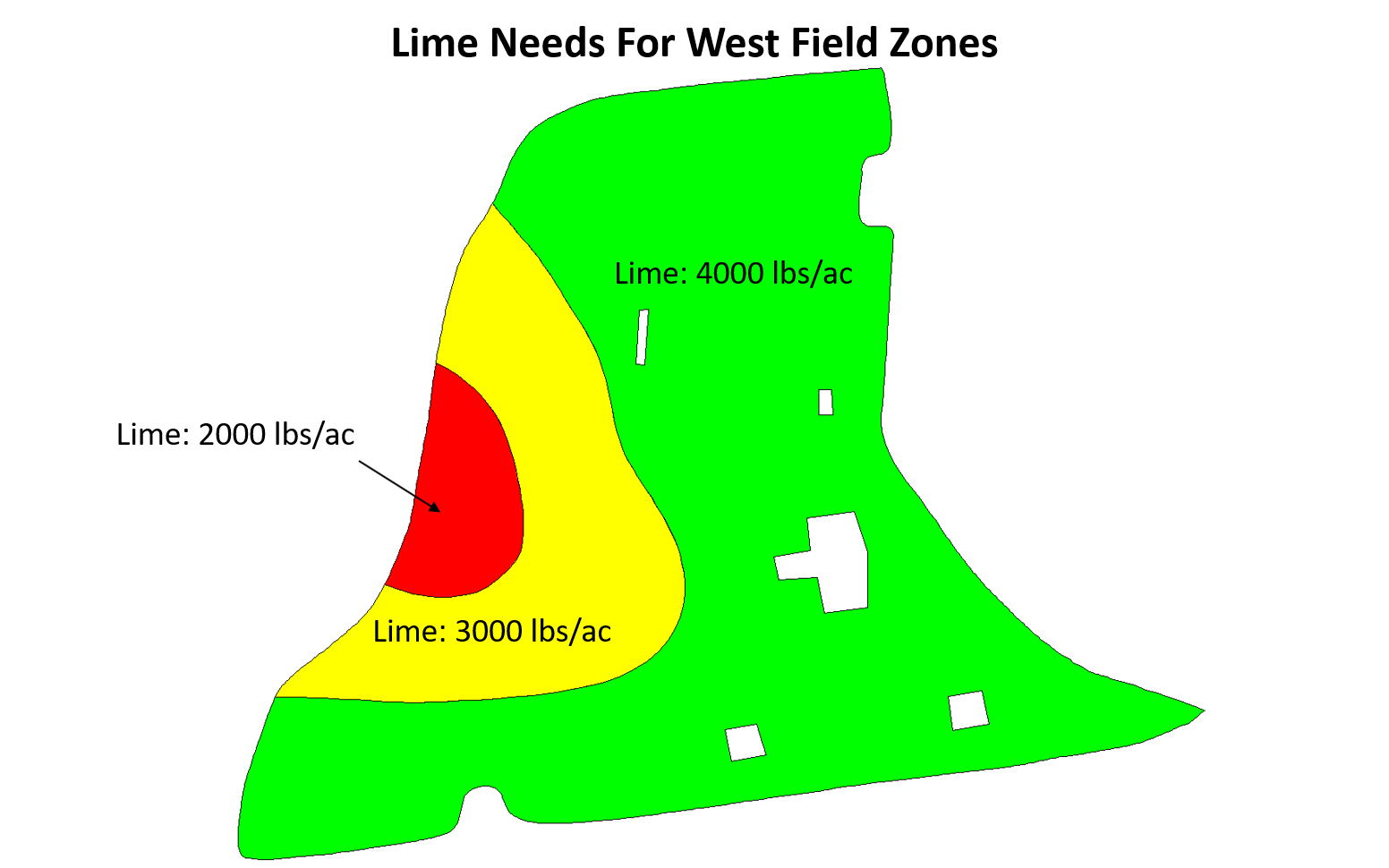
A prescription map for lime was created in Ag Leader SMS using the grid soil results from the fall soil testing. Figure 1 shows the prescription map used to apply lime using ABAC’s variable rate lime spreader. Lime was applied on November 29, 2023 to allow time for the lime to react with the soil to increase the pH.
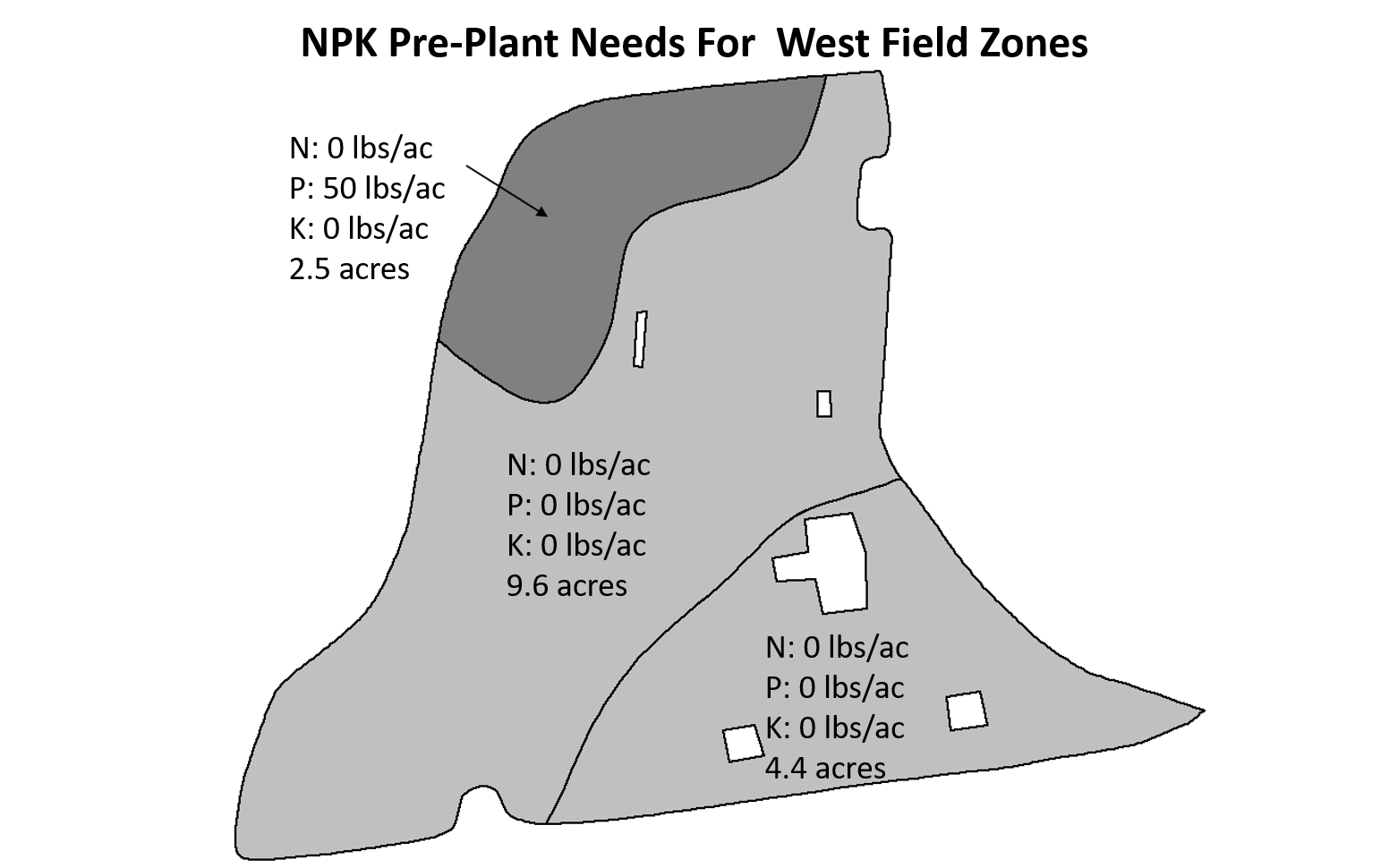
The soil test results in Appendix E show that the only pre-plant fertilizer needs to be met are in a 2.5-acre zone in West Field. This zone needs an application with a rate of 50 lb./ac. of phosphorus according to UGA recommendations.
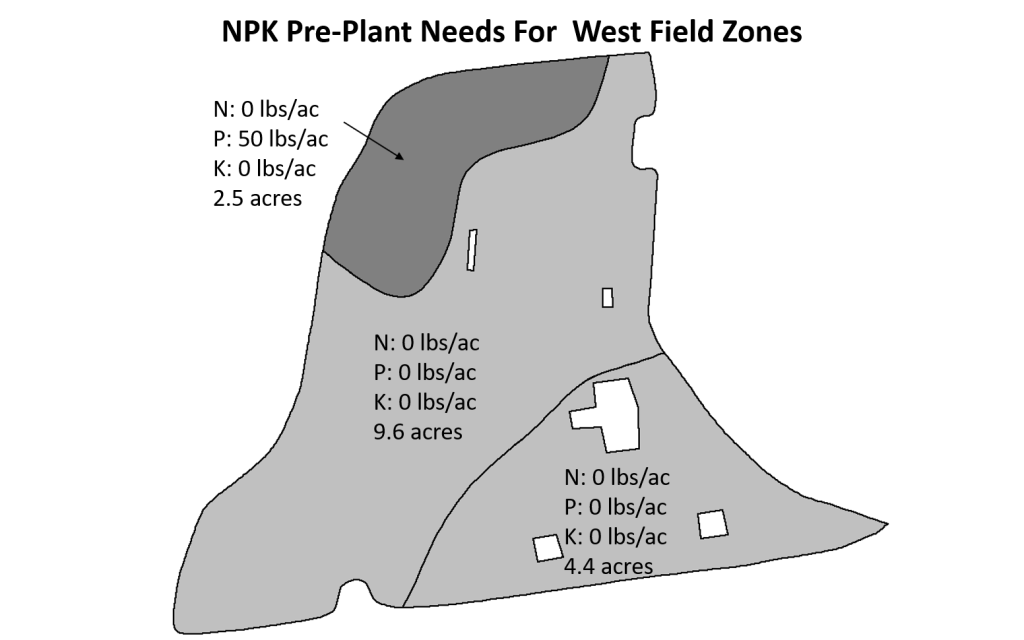

Additional fertilizer applications to meet UGA recommendations.
These fields are dryland fields without irrigation capabilities, but the soil moisture levels will still be monitored. Watermark soil moisture sensors were placed in the fields that transmit data through a RealmFive base station which logs on site weather data. The location for the field sensors was chosen based on EC zones and elevation.
The herbicide plan for Front Field and West Field will come from Dr. Prostko’s 2024 Peanut/Field Corn/Soybean Weed Control Recommendations.
At planting, Thimet (phorate) will be placed in furrow using the planter’s electric drive insecticide hoppers. The rate will be 5 lb/ac as recommended in the UGA Pest Management Handbook Peanut Section4 for at-plant thrips treatment.
Weekly crop scouting on foot paired with aerial imagery captured by a DJI 3M multispectral Unmanned Aerial Vehicle (UAV) will be used to detect the presence of insects or diseases in the crop. The scouting reports and UAV maps will be analyzed to measure damage. Treatment from the production handbook will occur for any detected issues when an economic threshold is reached which justifies the cost . Using standard integrated pest management (IPM) practices, the affected area will be measured to determine yield loss and calculate cost of treatment. When yield loss exceeds the cost of treatment then an application will be made.
The adjusted growing degree day model in the production guide will also be used to track crop’s maturity. The aGDD for the crop will be calculated using data collected by the onsite RealmFive weather station. The production guide says a total of 2500 aGDD’s is the optimal harvest for current peanut cultivars. At the 2300 GDD threshold, the fields will be using the wet blasting method. The sample will be placed on a peanut profile color chart to measure the coloration and determine the maturity categories to predict a harvest date. Once the optimum maturity is reached, a KMC two row peanut digger will be used to dig and invert the peanuts and a peanut combine (either Older KMC or new KMC) with a yield monitor will be used for harvest.
Subscribe to get the latest posts sent to your email.