Deltapine,DP2127, cotton will be planted in the South Pivot field at ABAC’s DATA Farm. This field is 11-acresand irrigated by a center pivot. The soil in South Pivot is classified as Tifton Loamy Sandy with 2 to 5 percent slope according to USDA’s Web Soil Survey tool. Currently the field is planted in Nelson annual ryegrass for winter coverand ABAC’s Beef Unit to cut and bale.Table 1 shows the crop rotation history of this field back to 2017 when the property was purchased by ABAC.Cotton was chosen for the 2024 crop season to follow last year’scorn crop. The yield goal for this crop is set at 1500 poundsper acre because of the irrigation capabilities versus dryland. This document outlines the season plan for the crop based on the print version of the 2024 UGA Cotton Production Guide (the digital copy posted is still the 2023 UGA Cotton Production Guide)and UGA Crop Code Sheet for 1500 lb/ac Cotton. Appendix A contains an operational timeline for this year’s crop in South Pivot.
Figure 1. DATA Farm Field Map
South Pivot Crop History
Year
Crop
2023
Corn
2022
Peanut (UGA trial)
2021
Cotton
2020
Soybeans
2019
Cotton
2018
Millet
2017
Cotton
Planting
Before planting, the cover crop will be terminated using herbicides; details are listed in the weed management section. One week after this application, a 4-row KMC 6700 Series Rip/Strip with a cover crop roller accessory will be run through the field to shatter any compaction in the rooting zone and remove cover crop residue for the planter row units. This method creates a clean path for the planter row units but will leave a residue mat from the cover crop in between the rows for weed suppression and moisture retention.
The cotton planting population target rate will be 29,040 seeds per acre for 2 seeds per foot. The actual planter setting will be 32,000 seeds per acre to account for germination issues. The ABAC Harvest International 4-row, 12-foot, planter will be used for planting. This planter is equipped with John Deere ME5 meters, Ag Leader SureDrive electric seed meters, Ag Leader SureForce hydraulic downforce, Yetter manually adjusted row cleaners, Ag Leader liquid control for in-furrow product application, and Kinze electric drive insecticide hoppers (see Insect Control section for product application details). The planter will be set to plant seeds at a depth of 0.75 inches.
The seed variety chosen from Deltapine was DP2127. This is an early—mid-maturity variety that had the highest lint yield and seed cotton yield in the 2023 UGA Variety Trials3. Appendix C contains information published by Delta Pine on their website for this variety. The variety also contains Bollgard 3 XtendFlex technology, which protects against armyworm and cotton bollworm. Herbicide-resistant technology allows the use of glyphosate, glufosinate, or dicamba.
The planting date will be chosen using the UGA Cotton Production Guide (2024) methodology that uses 4-inch soil temperatures (65oF minimum over 3 consecutive days) and a 5-day weather forecast showing warming conditions. There are four RealmFive soil temperature sensors at a 4-inch depth in the South Pivot field to monitor soil temperature. The production guide1 also states on page 76, “Irrigated cotton should be planted after May 1, since the risk of having adequate moisture for emergence is eliminated, the possibility of boll rot from August rains is reduced, and thrips pressure is lessened.”
Fertilization
Total Seasonal Needs
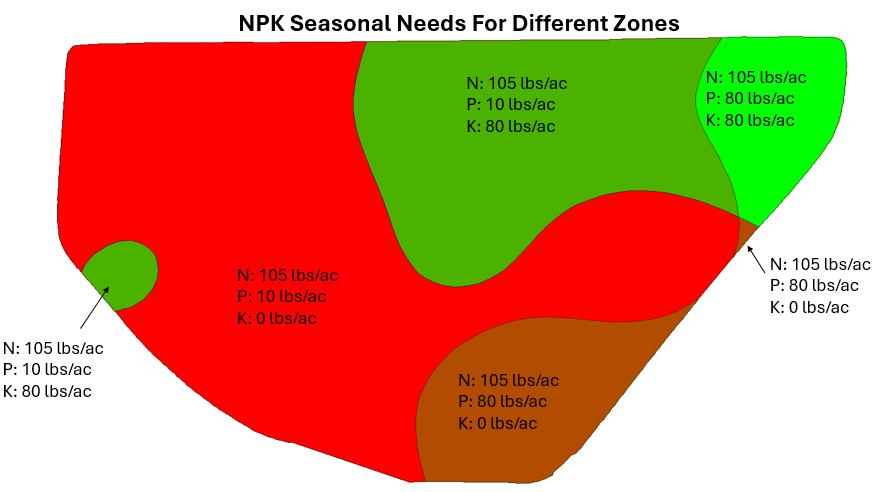
Figure 2. Total Seasonal Fertilizer Needs
Total NPK fertility needs for the 2024 season are shown in Figure 2. The nitrogen rate is set across the entire field, this will be split into a pre-plant application of 35 lbs./ac. and a side dress application of 70 lbs./ac. The P and K needs vary based on results from the grid soil test. There are two P zones, 9 acres needs 10 lbs./ac. while there are 2 acres that need 80 lbs./ac. of P. For K needs, 7.5 acres of the field does not need additional K, but 3.7 acres of the field needs an additional 80 lbs./ac. of K. The application options to address these needs are discussed in the following sections.
Liming
A prescription map for lime was created in Ag Leader SMS using the grid soil results from the fall soil test results(see appendix D for results). The pH was consistent, so a blanket rate of 1000 lbs. per acre was chosen. Figure 3shows the prescription map used to apply lime using ABAC’s variable rate lime spreader.Lime was applied on January 24, 2024, to allow time for the lime to react with the soil.
Figure 3. Lime Prescription Map
Pre-Plant Fertilizer
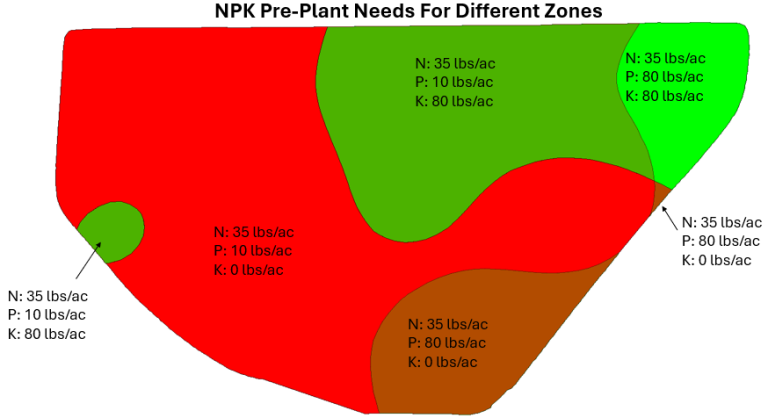
Figure 4. Phospohorus and potassium zones and rate. Flat nitrogen rate is included with each zone.
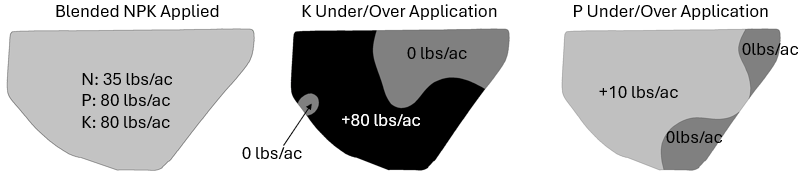
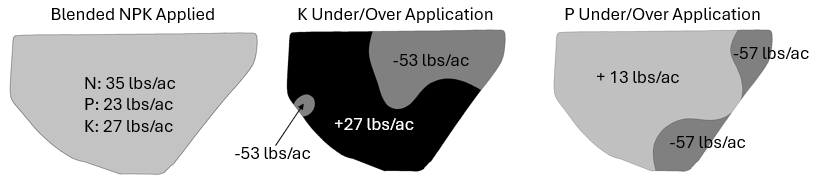
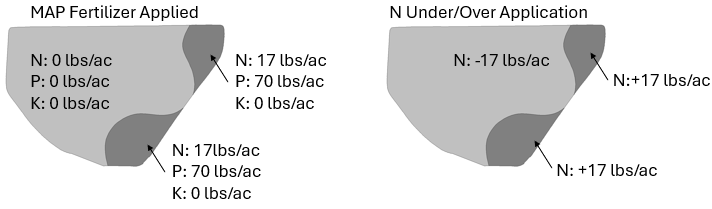
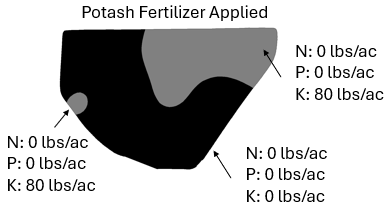
Phosphorus, potassium, and nitrogenneeds in the field are shown in Figure 3.Note that nitrogen application for cotton is flat rate per the UGA recommendation.An initial application of nitrogen35lb/ac is recommended during pre-plant fertilizer application. To address the variablephosphorus and potassium needs of the crop, three options for pre-plant fertilizer are presented below. All options were developed based on readily available granular products (monoammonium/diammoniumphosphate product (MAP/DAP 10–41-0), potash (0-0-60), ammonium sulfate (21-0-0-3)).Options 1 and 2 use a set rate across the field in a single operation (Figures 4 and 5), and option3utilizes variable rates but requires multiple passes across the field (Figures 6,7, and 8).An economic analysis of the three options is included inAppendix B.
Additional fertilizer applications are needed to meet UGA recommendations (Figure 3). Applications are constant rates across the field.
Side-Dress between first square and first bloom
Ammonium Sulfate (18-0-0-3) at a rate of 389 lb/ac or 34 gal/ac
Operation Cost: $50.09/ac
Irrigation
Irrigation of the cotton will be provided using the Valley center pivot based on Watermark soil moisture sensors located in the field that transmit data through a RealmFive base station which logs on site weather data. The location for the four in field sensors was chosen based on EC zones, elevation, and location under pivot towers. Each sensor site has a soil probe to monitor the moisture level at 8 inches, 16 inches, and 24 inches. A weighted sensor thresholdof 45kPa will be used to trigger irrigation events during the crop seasonbased on Dr. Wes Porter’s research.
Weed Management
The weed management for the crop will begin with the cover crop burndown application. An Extension article from Dr. Culpepper4 contains a recommendation for Glyphosate plus 2,4-D and Valor. The Glyphosate will terminate the cover crop, the 2,4-D and Valor will provide residual weed control. The Georgia Pest Management Handbook for Cotton was used to determine these rates: Glyphosate (30 oz/ac), 2,4-D (9 oz/ac), Valor (2 oz/ac).
The article recommends an at-plant application of Brake (1 pt/ac) plus Warrant (32 – 40 oz/ac). Two post-emergence applications are recommended. The first will be made 15 to 17 days after planting using a combination of Liberty (29-43 oz/ac), Glyphosate (21 – 60 oz/ac), and Dual Magnum (1 pt/ac). The second will be made 15-17 days after the first application using a combination of Liberty and Dual Magnum. A directed layby application of Diuron (1.6 – 2.4 pt/ac) with MSMA (2 pt/ac) will be made to control weeds without applying to the cotton plants.
Insect Control
At planting, AgLogic (aldicarb) will be placed in furrow using the planter’s electric drive insecticide hoppers. The rate will be 5 lbs/ac as recommended in the UGA Pest Management Handbook Cotton Section5 for at-plant thrips treatment.
Weekly crop scouting on foot paired with aerial imagery captured by a DJI 3M multispectral Unmanned Aerial Vehicle (UAV) will be used to detect the presence of insects or diseases in the crop. The scouting reports and UAV maps will be analyzed to measure damage. Treatment from the production handbook will occur for any detected issues when an economic threshold is reached which justifies the cost. Using standard integrated pest management (IPM) practices, the affected area will be measured to determine yield loss and calculate cost of treatment. When yield loss exceeds the cost of treatment then an application will be made.
Harvest
The team is looking for someone to harvest the crop with a roller picker that has a functioning yield monitor system.
Discover more from 4D Farm
Subscribe to get the latest posts sent to your email.