North Pivot is a 14-acre field at ABAC’s DATA Farm that is irrigated by a center pivot. Currently the field is planted in a cereal rye and clover mix for winter cover.Table 1 shows the crop rotation history of this field going back to 2017 when the property was purchased by ABAC.Corn was chosen for the 2024 crop season to follow last year’s peanut plots. The yield goal for this crop is set at 250 bushels per acre because of the irrigation capabilities versus dryland. This document outlines our season plan for the crop based on the 2024 UGACorn Production Guide and UGA Crop Code Sheet for 250 bu./ac. Irrigated Corn.
Figure 1. DATA Farm Field Map
North Pivot Crop History
Year
Crop
2023
Peanut (UGA trial)
2022
Cotton
2021
Soybeans
2020
Cotton
2019
Soybeans
2018
Cotton
2017
Millet
Planting
Before planting, the cover crop will be terminated using herbicides, then a strip till implement will be run through the field to shatter any compaction in the rooting zone and remove cover crop residue for the planter row units. This method creates a clean path for the planter row units but will leave residue from the cover crop in between the rows for weed suppression and moisture retention.
The corn planting population target rate will be 32,000 seeds per acre. Actual planter setting rate will be set to 33,000 seeds per acre to account for germination issues per the 2024 UGA Corn Production Guide. The ABAC Harvest International 4-row, 12-foot, planter will be used to plant corn. This planter is equipped with John Deere ME5 meters, Ag Leader electric drive on the meters, Ag Leader hydraulic downforce, and in-furrow liquid fertilizer. The planter will be set to plant seeds 2 inches deep with in-furrow pop-up fertilizer (product details in the fertilizer section) applied through the liquid system.
The seed varieties available to us from Pioneer were narrowed down using data from the UGA 2023 Corn Variety Trials. P1608YHR was chosen based on its performance in the variety trial and data from Pioneer’s research comparing their hybrid’s.
The planting date will be chosen using the UGA Corn Production Guide (2024) methodology that uses 2-inch soil temperatures (55oF minimum) and a 7-day weather forecast not showing low temperatures or rain that could create cool moist soil conditions. There are four RealmFive soil temperature sensors at a 2-inch depth in the North Pivot field to monitor soil temperature. The production guide also states that for rapid germination and consistent emergence, the optimal 2-inch soil temperature is greater than or equal to 60oF. An average daily soil temperature and extended weather forecast will be monitored starting March 1st. Therefore, average soil temperatures of 60oF will be used as a threshold unless the last desired planting date of March 31st is reached.
Fertilization
Total Seasonal Needs
Liming
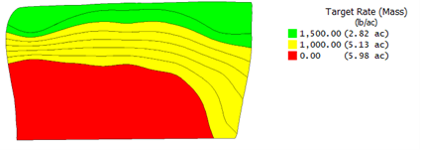
A prescription map for lime was created in Ag Leader SMS using the grid soil results from the fall soil testing. Figure 2 shows the prescription map used to apply lime using ABAC’s variable rate lime spreader.Lime was applied on January 24, 2024 to allow time for the lime to react with the soil to increase the pH.
Figure 2. variable rate lime prescription map
Pre-Plant Fertilizer
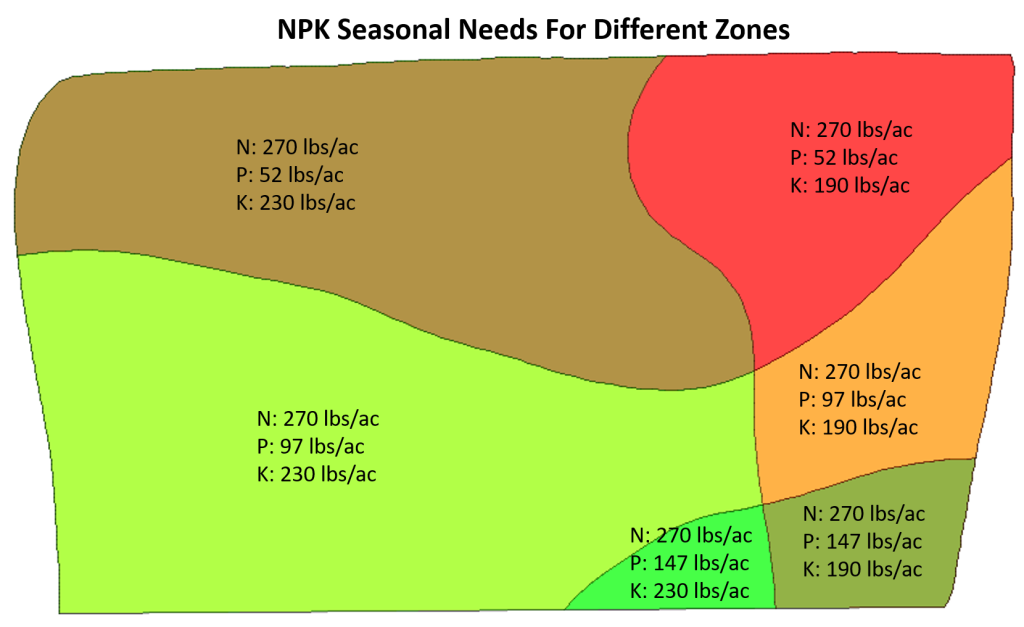
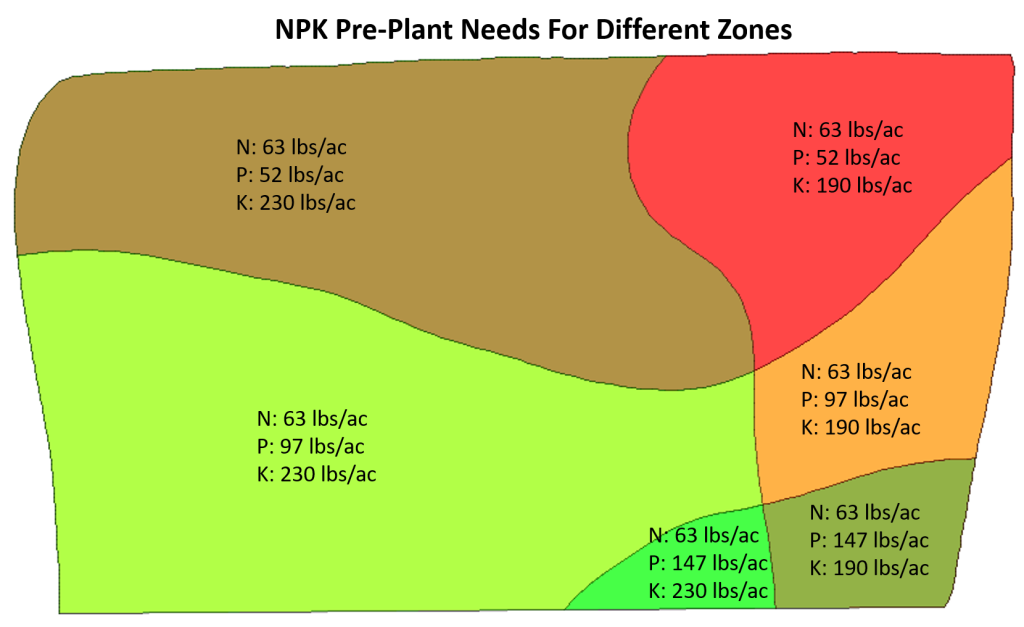
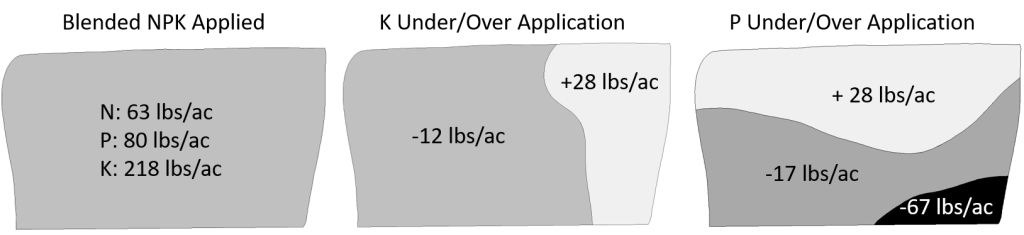
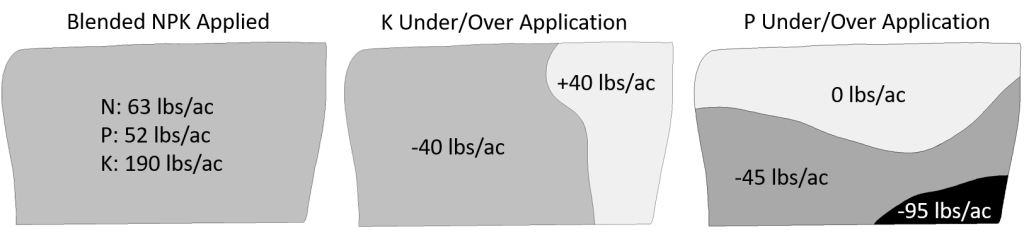
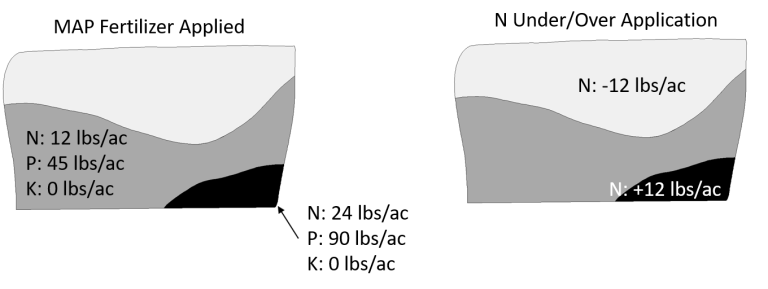
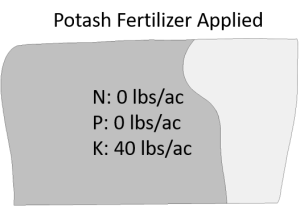
The variation of phosphorus and potassium needs in the field are shown in Figure 3.Nitrogen application for corn is flat rate per the UGA recommendation.An initial application of 63 lb/ac is recommended during pre-plant fertilizer application. To address the variable nutrient needs of the crop, four options for pre-plant fertilizer are presented below. All options were developed based on readily available granular products (monoammonium phosphate (MAP 12-52-0), potash (0-0-60), ammonium sulfate (21-0-0-3)). Two options use a set rate across the field in a single operation (Figures 4 and 5), and two options utilize variable rates but require multiple passes across the field (Figures 6 through 10).Economic analysis of the four options are included inAppendix B.
Figure 3. Phosphorus and potassium zones and rates. Flat nitrogen rate is included with each zone.
Pre-Plant Option 1
NPK Blend spread overfield
Cost: $241.26/ac.
Time: 1.5 hr.
Pre-Plant Broadcast Option 1 – Single Pass
Monoammonium Phosphate (MAP 12-52-0)
Potash (0-0-60)
Ammonium Sulfate (21-0-0-3)
Figure 4. Pre-Plant Option 1 Nutrient Maps
Pre-Plant Option 2
NPK Blend Based On Weighted Average P & K Needed
Cost: $201.61/ac.
Time: 1.5 hr.
Pre-Plant Broadcast Option 2 – Single Pass
Monoammonium Phosphate (MAP 12-52-0)
Potash (0-0-60)
Ammonium Sulfate (21-0-0-3)
Figure 5. Pre-Plant Option 2 Nutrient Maps
Pre-Plant Option 3
3 Passes Applying Nutrients To Address P & K Variability
Additional fertilizer applications to meet UGA recommendations. Applications are constant rates across the field. Side-dress applications have the potential to be variable rate with input from NDVI (or other indices) from in-season UAV monitoring.
At Plant In-Furrow
Ammonium Polyphosphate (10-34-0) at a rate of 6 gal./ac.
1st Side-Dress @ V2 growth stage
Ammonium Sulfate (18-0-0-3) at a rate of 500lb./ac.
2nd Side-Dress @ V4 growth stage
Ammonium Sulfate (18-0-0-3) at a rate of 500lb./ac.
Irrigation
Irrigation of the corn will be provided using the Valley center pivot based on Watermark soil moisture sensors located in the field that transmit data through a RealmFive base station which logs on site weather data. The location for the four in field sensors was chosen based on EC zones, elevation, and location under pivot towers. Later in the spring the pivot will be updated to variable rate on a nozzle-by-nozzle control. A map of the field EC zones will be used to develop irrigation zones map. Dr. Wes Porter will set sensor thresholds based on his research to trigger irrigation events during the crop season.
Scheduling details are still being determined. The process will include monitoring soil moisture measurements.
Weeklycrop scoutingon foot paired with capturing aerial imagery using a drone will be used to detect the presence of insects or disease in the crop. Treatment from the production handbook will occurfor any detected issues whenan economic thresholdis reached which justifies the cost.
Harvest
The two varieties selected have a maturity length of 116 days. Based on the targeted plant date of late March, the crop should reach maturity during the last week of July. The dry down period will begin at this point. A 15% moisture harvest will take place. The crop will be harvested using UGA’s John Deere 9410 grain combine. This combine was equipped with an Ag Leader yield monitoring system to record yield and moisture data tagged with RTK GPS location for analysis.
Discover more from 4D Farm
Subscribe to get the latest posts sent to your email.